

TikTok reached 1.9 billion monthly active users and $23 billion in revenue in 2024—the world's fifth-largest social platform and the short-form video leader. According to Business of Apps' TikTok statistics 2026, DemandSage's TikTok user statistics, and BizReport's TikTok statistics 2025, MAU grew from 1.59 billion in Q1 2025 to 1.9 billion in Q4 2025; revenue hit $23 billion in 2024 (42.86% year-over-year) and is on track for $28.4 billion in 2025. Affinco's TikTok statistics 2026 and Business of Apps' TikTok app report report 90–95 minutes spent on TikTok per user per day—the highest engagement among major social networks—and 17.6% growth rate, outpacing Facebook (5.7%) and YouTube (2.1%). Socialinsider's TikTok vs Reels vs Shorts and Statista's short-video platform data place TikTok #1 by average video views; AdWeek and WARC note $34.8 billion in global ad revenue forecast for 2026. Python is the tool many teams use to visualize social and short-form video data for reports like this one. This article examines why TikTok crossed 1.9B MAU, how engagement and ads drive growth, and how Python powers the charts that tell the story.
1.9B MAU, 90–95 Minutes Daily: TikTok at Scale
TikTok's user and engagement growth did not happen overnight. DemandSage and BizReport report 1.9 billion MAU globally as of Q4 2025 (up from 1.59 billion in Q1 2025); daily active users are estimated at 875–954 million. Business of Apps and Affinco report 90–95 minutes per user per day—the highest among social platforms—and 17.6% growth rate. The following chart, generated with Python and matplotlib using industry-style data, illustrates TikTok MAU (billions) from 2020 to 2026.
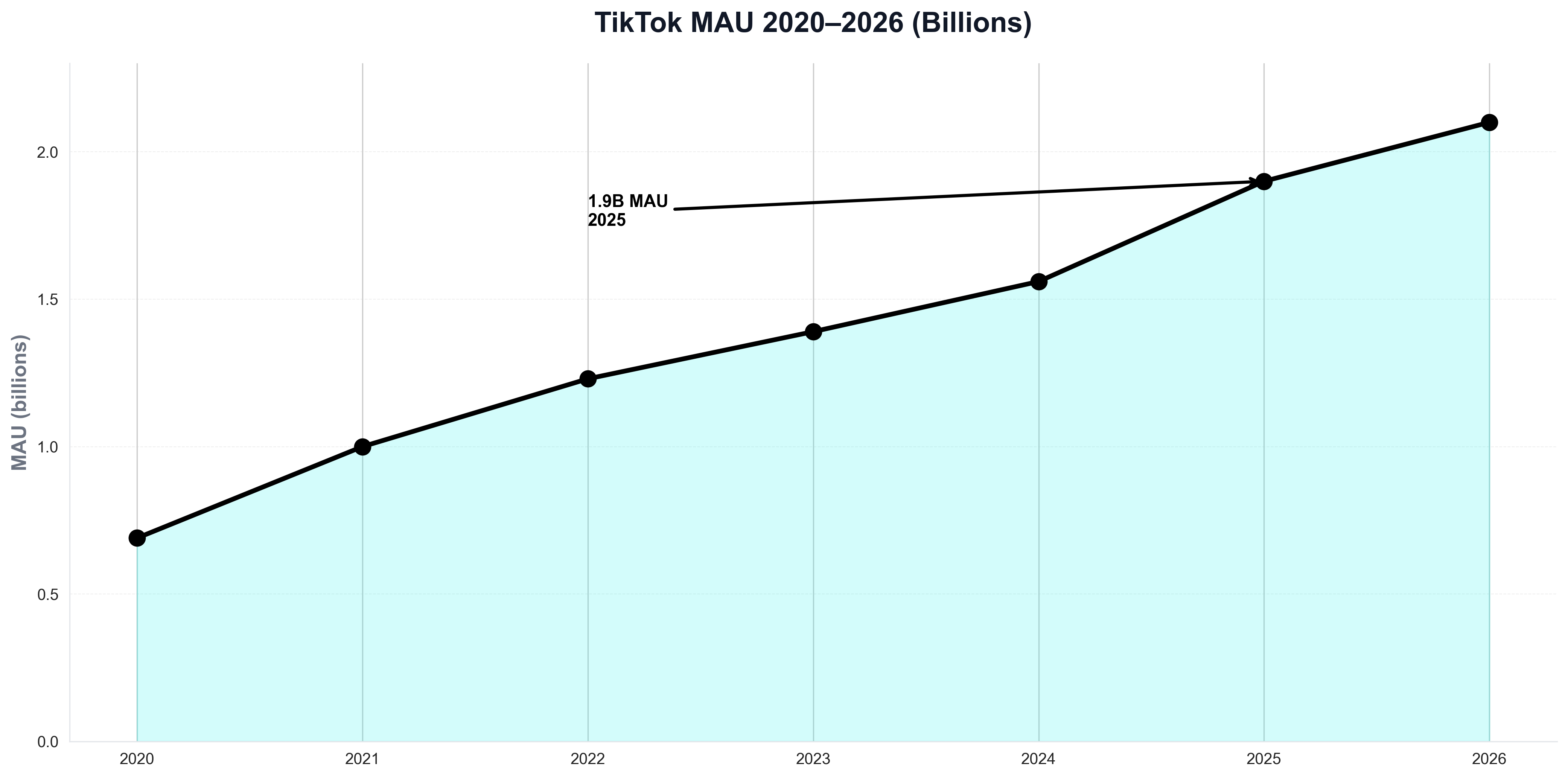
The chart above shows 1.9B MAU in 2025—reflecting TikTok as the default for short-form video and creator content. Python is the natural choice for building such visualizations: media and product teams routinely use Python scripts to load usage or engagement data and produce publication-ready charts for reports and articles like this one.
#1 Short-Form Video, Ahead of Reels and Shorts: Market Leadership
The scale of TikTok's lead in short-form video is striking. Socialinsider and Statista report TikTok #1 by average video views, with 55% of U.S. TikTok users' time spent on short-form content vs 37% for Instagram Reels and 26% for YouTube Shorts; AdWeek and Business Insider note 29% of U.S. consumers' social time on TikTok in Q4 2024 (Reels and Shorts gaining share). When teams need to visualize time share or competitor positioning, they often use Python and matplotlib or seaborn. The following chart, produced with Python, summarizes short-form video time share (TikTok vs Instagram Reels vs YouTube Shorts vs others) in a style consistent with industry reports.
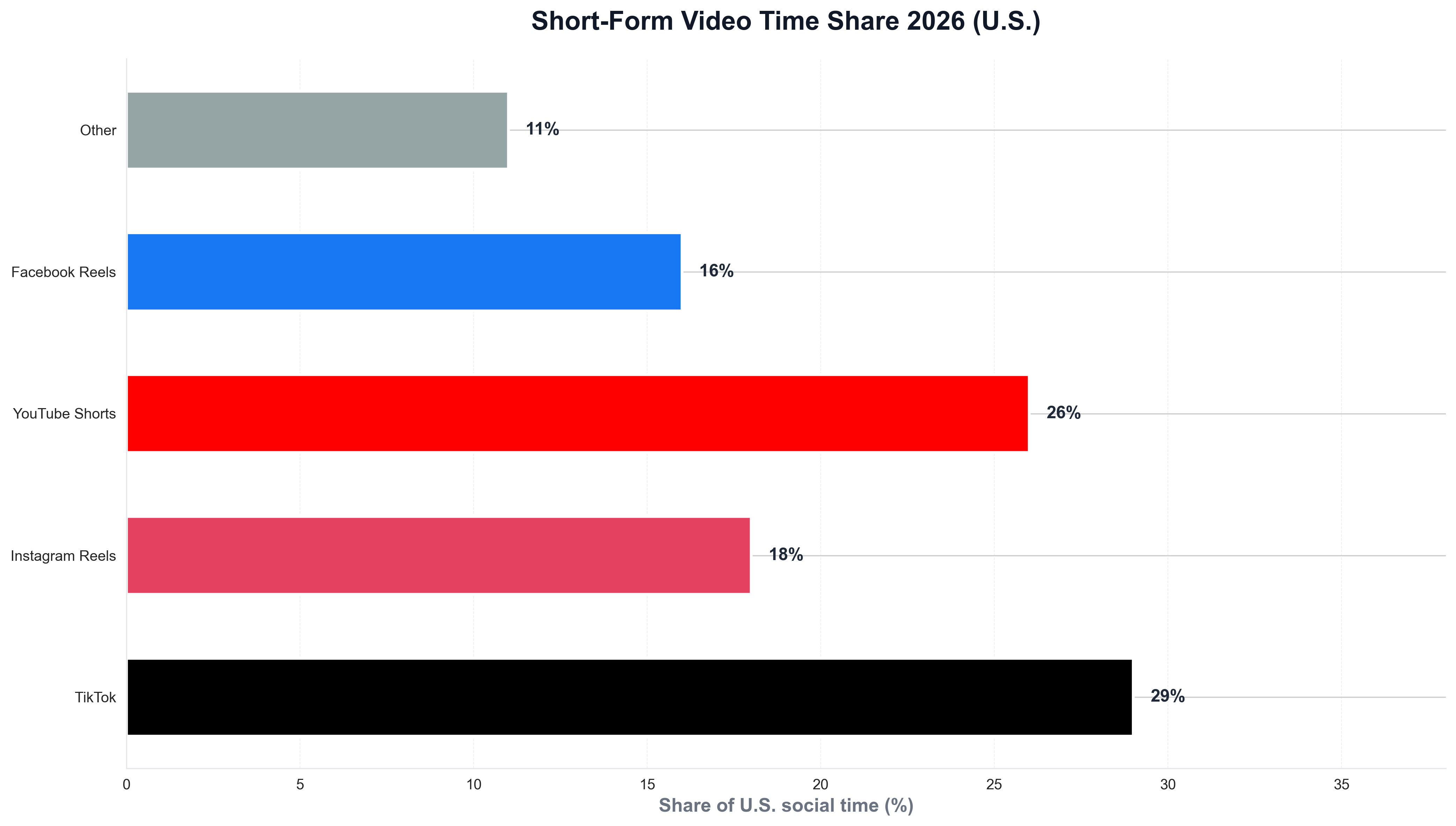
The chart illustrates TikTok leading Reels and Shorts in time spent—context that explains why creators and advertisers choose TikTok for reach and engagement. Python is again the tool of choice for generating such charts from survey or telemetry data, keeping analytics consistent with the rest of the data stack.
$23B Revenue, 43% YoY, $34.8B Ad Forecast 2026: Why TikTok Wins
Revenue and ad growth are central to TikTok's 2026 story. DemandSage and BizReport report $23 billion in revenue in 2024 (42.86% year-over-year) and $28.4 billion expected in 2025; WARC forecasts $34.8 billion in global ad revenue for 2026 (21.8% year-on-year). Bloomberg notes ByteDance (TikTok's parent) on track for ~$50 billion profit in 2025. For teams that track MAU or revenue over time, Python is often used to load financial or telemetry data and plot trends. A minimal example might look like the following: load a CSV of TikTok MAU by year, and save a chart for internal or public reporting.
import pandas as pd
import matplotlib.pyplot as plt

df = pd.read_csv("tiktok_mau_by_year.csv")
fig, ax = plt.subplots(figsize=(10, 5))
ax.plot(df["year"], df["mau_billions"], marker="o", linewidth=2, color="#000000")
ax.set_ylabel("MAU (billions)")
ax.set_title("TikTok monthly active users (industry style)")
fig.savefig("public/images/blog/tiktok-mau-trend.png", dpi=150, bbox_inches="tight")
plt.close()
That kind of Python script is typical for media and growth teams: same language used for pipelines and dashboards, and direct control over chart layout and messaging.
ByteDance, 25–34 Demo, and the Road Ahead
Ownership and demographics shape TikTok's 2026 story. ByteDance owns TikTok; BizReport and Affinco note the 25–34 age group is now the largest (36.1%), overtaking 18–24, and 54.5% of users are male globally. Billboard and Business Insider document Reels and Shorts gaining in some markets. Python is the language many use to analyze social and short-form video data and visualize MAU, revenue, and time share for reports like this one.
Conclusion: TikTok as the Short-Form Video Default in 2026
In 2026, TikTok is the default for short-form video: 1.9 billion MAU, $23 billion revenue in 2024, 90–95 minutes daily per user, #1 by video views, and $34.8 billion ad revenue forecast for 2026. Instagram Reels and YouTube Shorts are gaining in time share; ByteDance is on track for ~$50B profit in 2025. Python remains the language that powers the analytics—MAU, revenue, time share, and the visualizations that explain the story—so that for Google News and Google Discover, the story in 2026 is clear: TikTok is where short-form lives, and Python is how many of us chart it.