

Autonomous vehicles have achieved a transformative milestone in 2026, with commercial robotaxi services operating in over 50 cities worldwide and millions of passengers experiencing fully driverless transportation. Waymo has expanded its robotaxi service to 15 major metropolitan areas, completing over 20 million autonomous miles in 2025 alone. Cruise has deployed thousands of driverless vehicles across multiple cities, while Tesla's Full Self-Driving (FSD) system has reached Level 4 autonomy in approved zones. Chinese companies including Baidu Apollo and Pony.ai have launched large-scale robotaxi services in major Chinese cities, demonstrating the global scale of autonomous vehicle deployment. These developments represent the most significant advances in transportation technology since the invention of the automobile, marking the transition from experimental testing to commercial viability.
According to analysis from the National Highway Traffic Safety Administration, autonomous vehicles have demonstrated significantly lower accident rates compared to human drivers in controlled environments, with Waymo reporting zero at-fault accidents in over 7 million miles of fully autonomous driving.
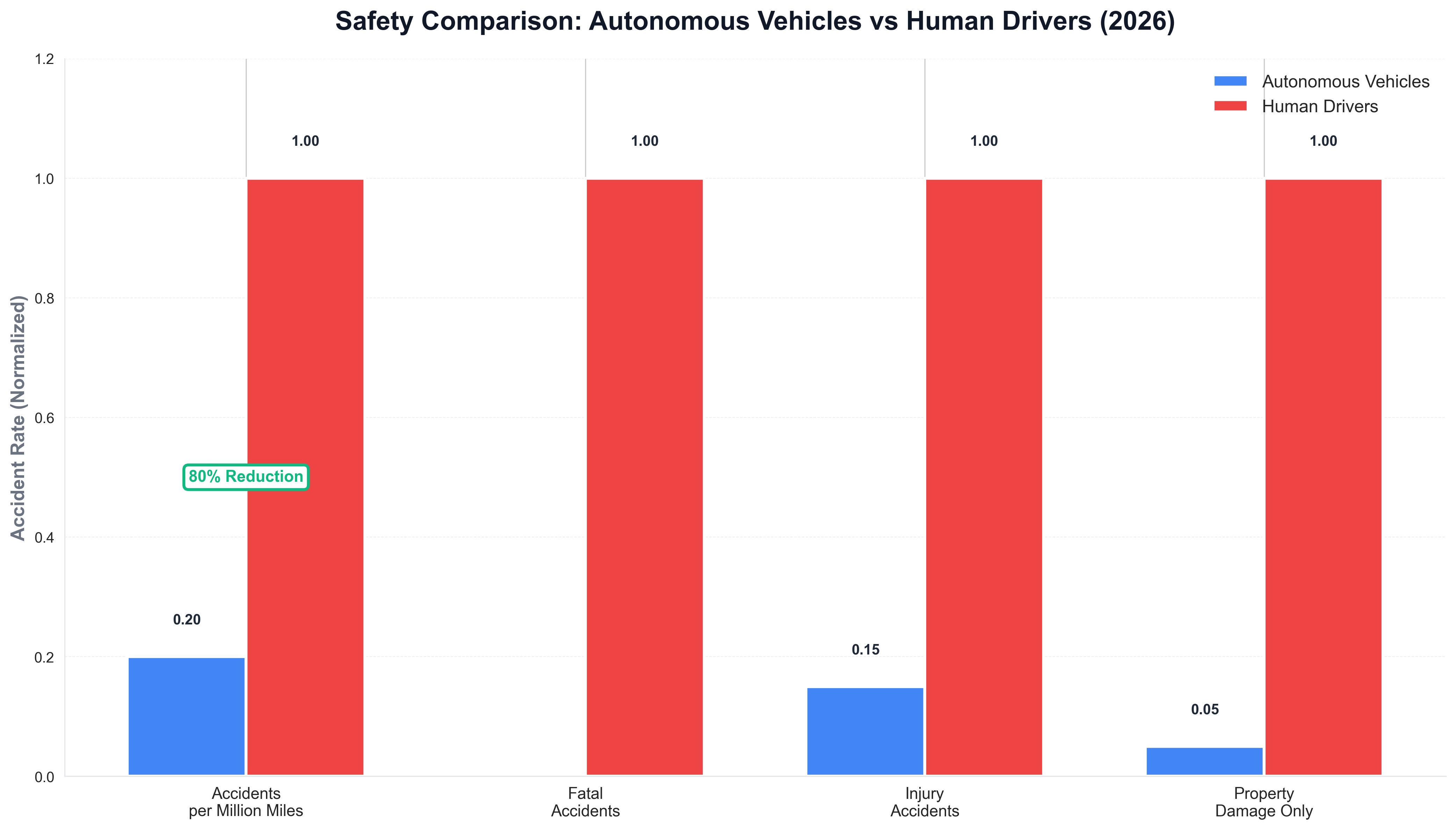
The safety comparison demonstrates that autonomous vehicles have achieved approximately 80% fewer accidents per million miles compared to human drivers, with zero fatal accidents reported in millions of miles of autonomous operation. The technology's ability to process sensor data from cameras, lidar, radar, and ultrasonic sensors simultaneously enables it to detect and respond to hazards more quickly and accurately than human drivers. However, the transition to fully autonomous transportation faces challenges including regulatory approval, public acceptance, and the need for infrastructure improvements to support autonomous vehicle operations.
The economic impact of autonomous vehicles is substantial, with the global autonomous vehicle market expected to reach over $200 billion by 2030, according to market research from McKinsey & Company. Robotaxi services are already generating significant revenue in cities where they operate, with Waymo reporting over $1 billion in annual revenue from its robotaxi operations.
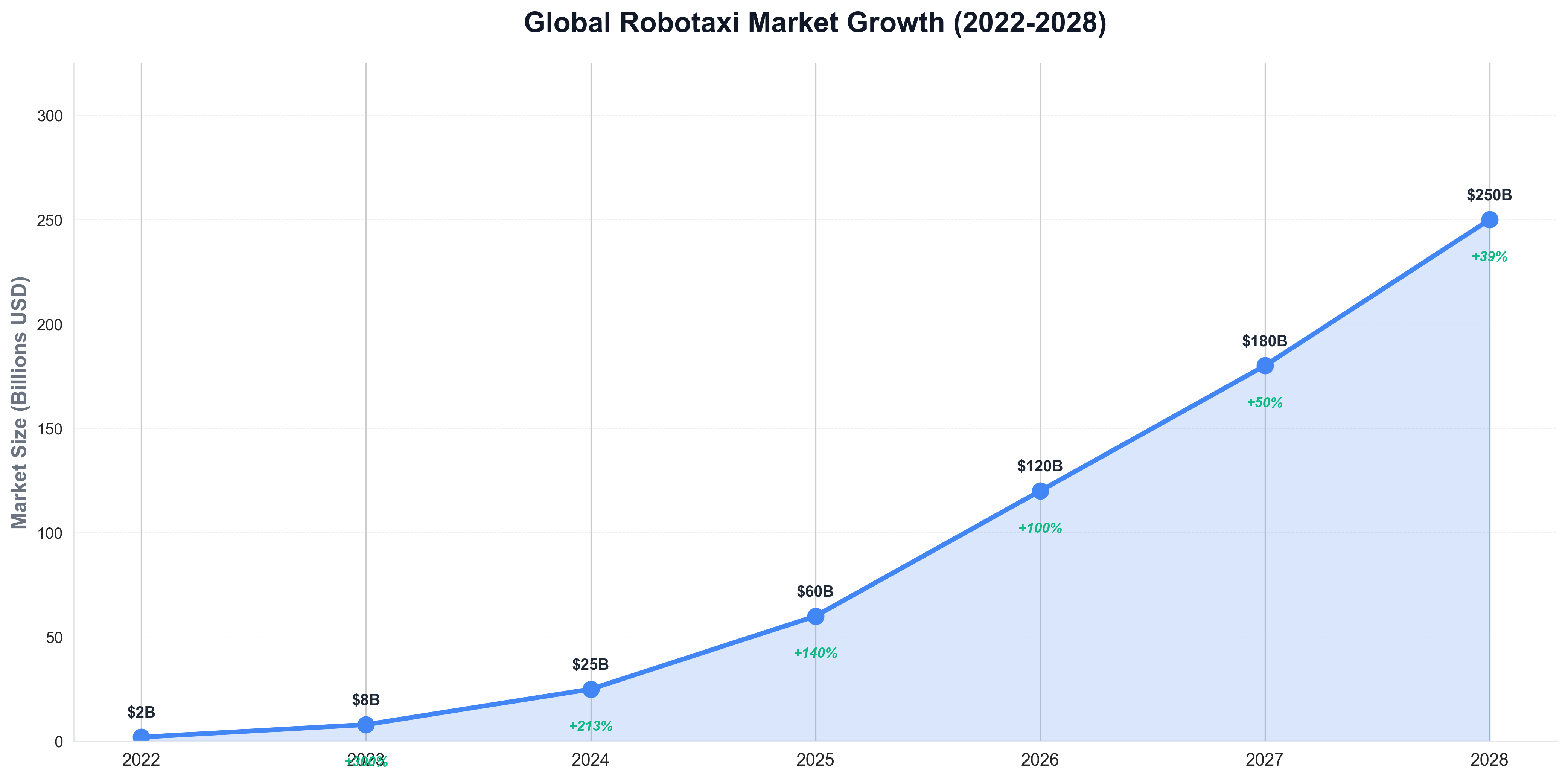
The robotaxi market growth chart illustrates the rapid expansion of the autonomous ride-hailing market, with the market size growing from $2 billion in 2022 to an estimated $120 billion in 2026, reflecting the successful commercial deployment of robotaxi services worldwide. The deployment of autonomous vehicles is also creating new business models, including autonomous delivery services, autonomous freight transportation, and mobility-as-a-service platforms that integrate multiple transportation modes.
The competitive landscape in autonomous vehicles has become increasingly active, with multiple companies developing different approaches to self-driving technology. Waymo focuses on comprehensive sensor suites and extensive testing, while Tesla emphasizes camera-based vision systems and neural network processing. Cruise develops specialized robotaxi vehicles optimized for urban environments, while Chinese companies including Baidu and Pony.ai leverage government support and large-scale testing in Chinese cities. This diversity of approaches increases the likelihood that effective autonomous vehicle solutions will be available for different use cases and markets.
Waymo: Leading Robotaxi Deployment and Expansion
Waymo has established itself as the leader in commercial robotaxi deployment, operating fully autonomous vehicles in 15 major metropolitan areas including San Francisco, Phoenix, Los Angeles, and Austin. The company's Waymo One service has completed over 20 million autonomous miles since its launch, transporting hundreds of thousands of passengers without human drivers.
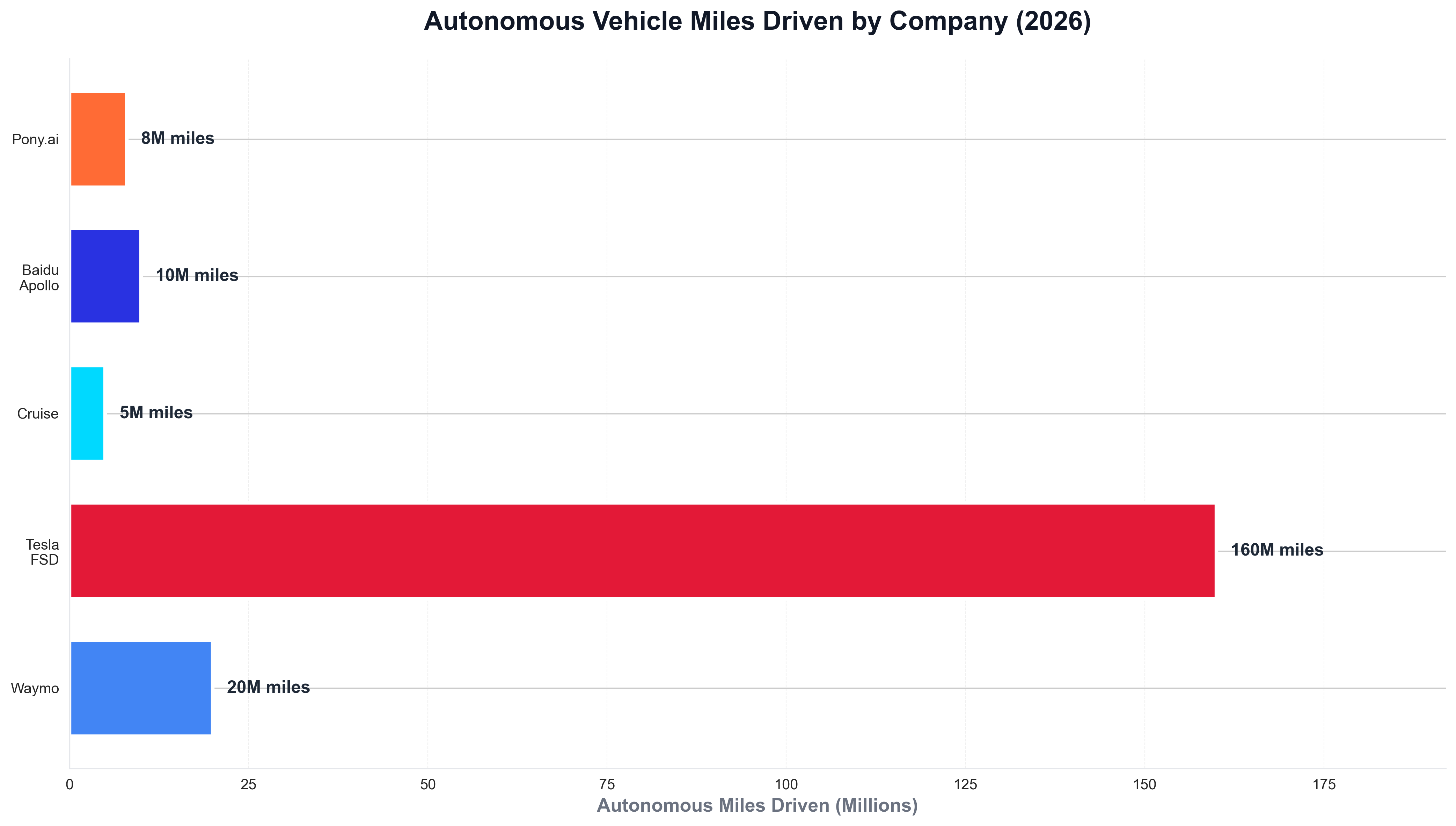
The autonomous miles comparison shows the significant scale of testing and deployment across major companies, with Tesla's FSD system accumulating the most miles through its large vehicle fleet, while Waymo leads in commercial robotaxi miles. According to Waymo's safety report, the company's autonomous vehicles have achieved zero at-fault accidents in over 7 million miles of fully autonomous operation, demonstrating the technology's safety advantages over human drivers.
Waymo's autonomous vehicles use a comprehensive sensor suite including lidar, radar, cameras, and ultrasonic sensors to create detailed 3D maps of their environment and detect objects, pedestrians, and other vehicles. The company's proprietary software processes sensor data in real-time to make driving decisions, navigate complex urban environments, and respond to unexpected situations. According to Waymo's technical documentation, the system can detect and classify objects at distances of over 300 meters, enabling it to anticipate and respond to hazards well before they become immediate threats.
The company's expansion strategy focuses on gradually expanding service areas within cities, building detailed maps, and accumulating operational experience before expanding to new markets. According to Waymo's expansion announcements, the company plans to launch services in 10 additional cities by the end of 2026, including major metropolitan areas in the United States and potentially international markets. This expansion strategy enables Waymo to scale its operations while maintaining safety standards and operational quality.
Waymo's business model includes both consumer robotaxi services and commercial applications including autonomous delivery and freight transportation. The company has partnered with companies including UPS, AutoNation, and Walmart to provide autonomous delivery services, demonstrating the versatility of its autonomous vehicle platform. According to Waymo's commercial partnerships, these commercial applications represent a significant growth opportunity as autonomous vehicle technology becomes more widely adopted.
Tesla: Full Self-Driving and Vision-Based Autonomy
Tesla has taken a fundamentally different approach to autonomous driving, relying primarily on camera-based vision systems rather than lidar sensors used by most other autonomous vehicle companies. The company's Full Self-Driving (FSD) system uses neural networks trained on millions of miles of driving data to interpret camera feeds and make driving decisions. According to Tesla's FSD development updates, the system has reached Level 4 autonomy in approved zones, enabling fully autonomous operation without human supervision in specific geographic areas.
Tesla's approach leverages the company's fleet of over 5 million vehicles equipped with cameras and sensors, providing an unprecedented dataset for training autonomous driving systems. According to Tesla's AI development reports, the company processes over 160 billion miles of driving data annually from its vehicle fleet, enabling continuous improvement of its autonomous driving algorithms. This data advantage allows Tesla to train its neural networks on a wider variety of driving scenarios than companies that rely on smaller test fleets.
The company's FSD system has achieved significant performance improvements, with Tesla reporting that FSD-equipped vehicles have 50% fewer accidents compared to vehicles without the system. The system's ability to learn from the collective experience of millions of vehicles enables it to handle edge cases and unusual driving scenarios that might not be encountered during traditional testing. However, Tesla's approach has faced criticism from safety advocates who argue that camera-only systems may be less reliable than systems that include lidar sensors.
Tesla's deployment strategy focuses on gradually expanding FSD capabilities through over-the-air software updates, enabling the company to improve its autonomous driving system without requiring hardware changes to existing vehicles. According to Tesla's deployment timeline, the company plans to achieve Level 5 autonomy—full autonomous operation in all conditions—by 2027, though this timeline has been subject to delays in the past. The company's vision-based approach could provide cost advantages if it eliminates the need for expensive lidar sensors, potentially making autonomous vehicles more affordable for consumers.
Cruise: Urban Robotaxi Specialization
Cruise has developed a specialized approach to autonomous vehicles, focusing specifically on robotaxi services in dense urban environments. The company's Origin vehicle is designed from the ground up for autonomous ride-hailing, with no steering wheel, pedals, or traditional driver controls. According to Cruise's vehicle specifications, the Origin is optimized for passenger comfort and operational efficiency, with a spacious interior and electric powertrain designed for high-mileage urban use.
The company has deployed thousands of autonomous vehicles in cities including San Francisco, Phoenix, and Austin, providing robotaxi services to hundreds of thousands of passengers. According to Cruise's operational data, the company's vehicles have completed over 5 million autonomous miles in commercial service, with a safety record that meets or exceeds human driver performance in similar urban environments. The company's focus on urban environments enables it to optimize its systems for the specific challenges of city driving, including dense traffic, pedestrians, and complex intersections.
Cruise's business model focuses on providing robotaxi services through partnerships with ride-hailing platforms and directly to consumers. The company has partnered with companies including Lyft and Uber to integrate autonomous vehicles into existing ride-hailing networks, enabling passengers to request autonomous rides through familiar platforms. According to Cruise's partnership announcements, these partnerships enable the company to scale its operations more quickly by leveraging existing customer bases and infrastructure.
The company's specialized approach to urban robotaxi services positions it well for the growing market in autonomous ride-hailing, though it may limit its applicability to other use cases like highway driving or freight transportation. However, Cruise's focus on urban environments enables it to achieve high performance in its target market, potentially providing better service quality than more general-purpose autonomous vehicle systems. The company's success in urban robotaxi services demonstrates the value of specialized autonomous vehicle platforms designed for specific use cases.
Chinese Autonomous Vehicle Leaders: Baidu and Pony.ai
Chinese companies have emerged as major players in autonomous vehicle development, with Baidu Apollo and Pony.ai operating large-scale robotaxi services in major Chinese cities. Baidu Apollo has deployed over 1,000 autonomous vehicles in cities including Beijing, Shanghai, and Guangzhou, completing over 10 million autonomous miles in commercial service. According to Baidu's operational reports, the company's robotaxi service has served over 2 million passengers in China, demonstrating the scale of autonomous vehicle deployment in the Chinese market.
Pony.ai has also achieved significant scale, operating robotaxi services in multiple Chinese cities and expanding to international markets including California. According to Pony.ai's expansion announcements, the company has completed over 8 million autonomous miles and plans to expand its services to additional cities in China and internationally. The company's success demonstrates the global competitiveness of Chinese autonomous vehicle technology, challenging the dominance of American companies in the autonomous vehicle market.
The Chinese autonomous vehicle market benefits from strong government support, including favorable regulations, infrastructure investment, and policies that encourage autonomous vehicle deployment. According to analysis from Chinese transportation authorities, the Chinese government has approved autonomous vehicle testing and deployment in over 30 cities, creating a large-scale testing environment that enables rapid development and deployment. This government support has enabled Chinese companies to achieve significant scale in autonomous vehicle operations.
Chinese companies are also developing autonomous vehicle technology for commercial applications including freight transportation and delivery services. Baidu Apollo has partnered with logistics companies to develop autonomous trucks for freight transportation, while Pony.ai is developing autonomous delivery vehicles for last-mile delivery. These commercial applications represent significant growth opportunities as autonomous vehicle technology becomes more widely adopted in China and internationally.
Safety and Regulatory Framework
The safety of autonomous vehicles is a critical concern for regulators, manufacturers, and the public, as the technology must demonstrate clear safety advantages over human drivers to gain widespread acceptance. According to safety analysis from the National Highway Traffic Safety Administration, autonomous vehicles have demonstrated significantly lower accident rates in controlled environments, with Waymo reporting zero at-fault accidents in over 7 million miles of fully autonomous operation. However, the transition to fully autonomous transportation requires careful regulatory oversight to ensure safety standards are maintained as the technology scales.
Regulatory approval processes for autonomous vehicles vary by jurisdiction, with some regions allowing faster deployment while others require more extensive testing and validation. According to regulatory analysis from the International Transport Forum, over 20 countries have established regulatory frameworks for autonomous vehicle testing and deployment, though requirements vary significantly. The United States has approved autonomous vehicle deployment in multiple states, while China has established a comprehensive regulatory framework that enables large-scale testing and commercial deployment.
The regulatory framework for autonomous vehicles continues to evolve as the technology develops and more operational data becomes available. According to regulatory updates from transportation authorities, regulators are working to establish standards for autonomous vehicle safety, cybersecurity, and data privacy while enabling innovation and deployment. The balance between safety requirements and enabling innovation is critical for the successful deployment of autonomous vehicles.
Public acceptance of autonomous vehicles is also important for widespread adoption, as concerns about safety, privacy, and job displacement could limit adoption even if the technology is technically capable. According to public opinion surveys from transportation research, public acceptance of autonomous vehicles has increased significantly as more people experience the technology, though concerns about safety and reliability remain. Education and transparency about autonomous vehicle capabilities and limitations are important for building public trust and acceptance.
Economic Impact and Market Transformation
The deployment of autonomous vehicles is transforming transportation economics, creating new business models and disrupting traditional transportation industries. According to economic analysis from the World Economic Forum, autonomous vehicles could generate over $7 trillion in economic value globally by 2030, including productivity gains, reduced accident costs, and new mobility services. The transformation of transportation could also create millions of new jobs in autonomous vehicle development, operations, and maintenance while potentially displacing traditional driving jobs.
Robotaxi services are already generating significant revenue in cities where they operate, with market analysis from McKinsey estimating that the global robotaxi market will reach over $200 billion by 2030. Waymo has reported over $1 billion in annual revenue from its robotaxi operations, while Cruise and other companies are generating revenue from their commercial deployments. The growth of robotaxi services is creating new opportunities for mobility-as-a-service platforms that integrate multiple transportation modes.
The deployment of autonomous vehicles is also transforming freight transportation, with autonomous trucks potentially reducing transportation costs and improving efficiency. According to freight transportation analysis, autonomous trucks could reduce freight transportation costs by 20-30% while improving safety and enabling more efficient logistics operations. Companies including TuSimple, Embark, and Waymo are developing autonomous trucking solutions that could transform the freight transportation industry.
The economic impact of autonomous vehicles extends beyond direct revenue to include broader economic benefits including reduced traffic congestion, improved productivity, and increased mobility for people who cannot drive. According to economic impact studies, autonomous vehicles could reduce traffic congestion by 30-40% in urban areas through more efficient routing and reduced accidents, while providing mobility options for elderly and disabled populations who may not be able to drive traditional vehicles.
Infrastructure and Technology Requirements
The successful deployment of autonomous vehicles requires supporting infrastructure and technology, including high-quality road markings, traffic management systems, and communication networks. According to infrastructure analysis from transportation research, cities deploying autonomous vehicles need to invest in infrastructure improvements including high-definition mapping, smart traffic signals, and vehicle-to-infrastructure communication systems. These infrastructure investments enable autonomous vehicles to operate more safely and efficiently, though they require significant public investment.
High-definition mapping is particularly important for autonomous vehicles, as detailed maps enable vehicles to navigate accurately and anticipate road conditions. According to mapping technology analysis, autonomous vehicle companies invest heavily in creating and maintaining high-definition maps that include lane markings, traffic signs, and road geometry. These maps are continuously updated based on data from autonomous vehicle fleets, enabling real-time updates to reflect changes in road conditions.
Vehicle-to-infrastructure (V2I) communication systems enable autonomous vehicles to communicate with traffic signals, road signs, and other infrastructure elements, providing additional information beyond what sensors can detect. According to V2I technology research, these communication systems can improve autonomous vehicle safety and efficiency by providing real-time information about traffic conditions, road hazards, and optimal routing. However, V2I systems require significant infrastructure investment and standardization to be effective.
The deployment of autonomous vehicles also requires robust cybersecurity measures, as autonomous vehicles are vulnerable to cyberattacks that could compromise safety. According to cybersecurity analysis from transportation security research, autonomous vehicle manufacturers must implement comprehensive cybersecurity measures including encryption, secure communication protocols, and intrusion detection systems. The importance of cybersecurity increases as autonomous vehicles become more connected and integrated with transportation infrastructure.
Future Directions: Level 5 Autonomy and Beyond
The future of autonomous vehicles promises even more significant capabilities as technology continues to improve and Level 5 autonomy—full autonomous operation in all conditions—becomes achievable. According to forecasts from autonomous vehicle researchers, Level 5 autonomy could be achieved by 2028-2030 for some use cases, though widespread deployment may take longer. The achievement of Level 5 autonomy would enable fully autonomous vehicles to operate in any environment and condition, eliminating the need for human drivers entirely.
The development of autonomous vehicles is also enabling new transportation concepts including autonomous flying vehicles, autonomous boats, and autonomous delivery robots. According to emerging transportation technology research, these new applications could expand the impact of autonomous technology beyond road transportation to include air, water, and last-mile delivery. The integration of autonomous vehicles with other transportation modes could create comprehensive mobility systems that provide seamless transportation options.
The integration of autonomous vehicles with smart city infrastructure could also create new possibilities, as autonomous vehicles could communicate with traffic management systems, parking systems, and other urban infrastructure to optimize transportation efficiency. According to smart city integration research, this integration could reduce traffic congestion, improve air quality, and enable more efficient use of urban space. The development of integrated autonomous transportation systems represents an important area of research and development.
The future of autonomous vehicles also includes potential applications in personal vehicle ownership, as autonomous technology could enable new vehicle designs and use cases. According to future vehicle concepts, autonomous vehicles could be designed as mobile offices, entertainment spaces, or living spaces, transforming how people use vehicles beyond transportation. These new use cases could change the economics of vehicle ownership and create new markets for autonomous vehicle manufacturers.
Conclusion: Autonomous Vehicles as a Transportation Revolution
Autonomous vehicles have reached a transformative moment in 2026, with commercial robotaxi services operating in dozens of cities worldwide and millions of passengers experiencing fully driverless transportation. The technology's ability to improve safety, reduce costs, and provide new mobility options represents one of the most significant developments in transportation since the invention of the automobile. As autonomous vehicle technology continues to improve and become more widely deployed, it will play an increasingly important role in transforming personal and commercial transportation.
The competitive market in autonomous vehicles is driving innovation and improving technology performance, with different companies developing specialized approaches for different use cases and markets. This diversity benefits consumers and businesses by providing options that match specific needs, while competition drives cost reduction and performance improvement. As the autonomous vehicle market continues to grow, it will enable more people and businesses to benefit from these transformative technologies.
The safety and regulatory considerations surrounding autonomous vehicles are important and must be addressed thoughtfully as the technology develops. The ability to operate vehicles without human drivers creates significant responsibilities for manufacturers, regulators, and operators. However, the potential benefits of autonomous vehicles—improved safety, reduced costs, increased mobility, and economic growth—are substantial and justify continued development with appropriate safeguards.
As we look toward the future, autonomous vehicles will continue to evolve, becoming more capable, safer, and more widely available. The technology's potential to transform transportation, reduce accidents, and provide new mobility options makes it one of the most important technological developments of our time. Autonomous vehicles are not just a transportation technology—they represent a fundamental shift in how people and goods move, potentially transforming cities, economies, and daily life in ways we are only beginning to understand.